

What is a ‘growth mindset? And how can developing a Growth Mindset help you when learning to draw and paint?
Little Art School online course student Mel Williams, an experienced teacher who has explored ‘growth mindset’ professionally and personally, explains how shifting your mindset can transform your art journey.

When Joanne asked me if I would like to write a blog post about how a growth mindset has been part of my art journey, I immediately said yes. As a fairly recently retired Primary School teacher, I wanted to learn to draw and paint and wanted something that was both grounded in the basic skills and also carefully progressive and supportive. The Little Art School was perfect for me and, after completing 3 Levels and now early into Level 4, I am amazed at the progress I’ve made.
Growth mindset development is now evident in many classrooms across the country, but perhaps less well known away from education. For me, learning about growth and fixed mindset many years ago was one of the biggest lightbulb moments in my teaching career and it became unbelievably influential in my classroom. So, I’ll try to give you a brief overview of what it is all about and how I have needed my own growth mindset whilst working through the Little Art School lessons.
A growth mindset is a concept developed by Stanford University psychologist Carol Dweck. People that practice a growth mindset recognise that every time you take yourself outside of your comfort zone, working hard and finding things challenging or even difficult, neurons in your brain build better connections and your skills and abilities develop and improve.
So, if you try to think with a growth mindset you can start to see effort, practice, difficulty and mistakes as signs that you’re improving rather than signs that you should give up. With a growth mindset you believe your skills, interests and talents grow and evolve over the course of your life. You have the ability to become a maths-person, art-person, sports-person, or people-person. You can grow and evolve; you can become someone who can draw and paint. The opposite of this would be fixed mindset, a mindset that I found was especially prevalent in the learning of maths in school and has also been said to be the case in the world of painting and drawing.
A fixed mindset is one that says we have a level of talent or skill that’s fixed (we’re born with) and that it’s very hard or impossible to significantly improve. When the fear of failure becomes too big to face and when the struggle becomes too big to overcome this is when we quit. If the words ‘I can’t draw,’ or ‘I’m not a talented painter,’ or ‘This painting is rubbish,’ have ever slipped out of your lips or run through your mind, that’s a sign of fixed mindset thinking. I certainly have found those thoughts popping into my mind at times during this course, the gouache beach huts, my first couple of paintings in pastel and the holly in acrylics come to mind.
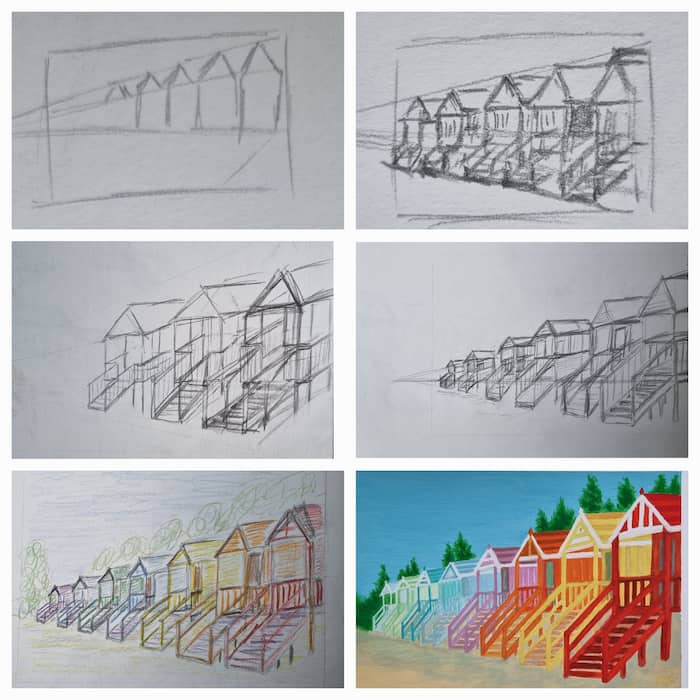
Dweck’s research has shown that if you cultivate a growth mindset, you’re able to learn from your mistakes, engaging fully with them, looking at how to improve, rather than avoiding them. Mistakes are how we learn and grow, they can point us in new directions, and guide us down new paths. If we change how we see our mistakes, they can begin to help us instead of hurt us. So, for me, doing some further sketches of the beach huts and using coloured pencils to work out which colour went where, helped me get better with each further attempt… and there were a few that were not at all successful in my eyes for sure!
Learning as an adult can be much tougher because our inner critic has become much more vocal, having been reinforced time after time, in school, in work and in our daily lives. We are ready to jump in and criticise our efforts in the wrong way. We all move quite fluidly from fixed to growth mindset thinking at different times in our lives and in different situations.
The good news is that we can consciously change the mindset we practice, the starting point being to recognise the fixed mindset thinking and re focus it. Instead of thinking you failed, you can think of yourself as not succeeding…YET. Then your mistakes will stop having such an emotional hold over you and can become a vital part of the process of improving. I know that I am still a little too focused on the outcome at times: the final painting or drawing. But the more I paint and draw, the more I become lost in the process and focus less on the outcome. I try to re-focus my thinking to what I have learned and how I can use that skill in a different context. I often try the new technique or idea again on a different subject or with a different colour choice. And sometimes I just play with the left-over paint or paper, not as something for show but for the joy or even the messiness if its acrylics. I know that practice makes … better.
So how can you begin to cultivate a growth mindset? The main thing is to focus on a process, not the end result. Also work on your self-talk: ‘I’m on the right track,’ or ‘I’ll use the art techniques I’ve learned,’ to improve. Change your thinking from ‘I can’t.’ to ‘I can’t YET ‘or ‘It went wrong!’ to ‘Where can I make that work better next time?’
When we’re learning something new, outside support can also help with our growth mindset thinking. We need someone, or ideally a community, who can remind us of the positive things they notice and encourage us to keep going. The Little Art School Online Course Facebook group and the monthly Zoom meet ups provide that for me. I think that without this, I might have lost the motivation to continue. No matter how good we get at drawing and painting, there will always be struggles and obstacles. So how great is it to have a positive Little Art School community to turn to. Spreading positive comments and encouragement to others is a great way to practise that language yourself. It can be a way to hear that positive inner voice and practise saying it out loud. Soon enough, you’ll be able to give yourself encouragement too.
So, praise yourself for the effort and perseverance you’ve shown, as well as any improvements, even if they seem really small. When I reached the end of Level 3, I went right back to look at my first painting and noticed the progress I had made. My art journey, so far, has had its ups and its downs but that is what should be, a journey not a destination, process not product and if I can’t do it yet, then I need to keep on learning and practising.

The Little Art School Team
Readers; we’d love to know your thoughts, let us know in the comments
If you are interested in learning to draw and paint the Little Art School way, find out more here
I couldn’t agree with you more Mel. I’m a retired child psychologist, and much of my work involved helping young people to engage in positive self-talk, and re-framing the way they saw themselves in their worlds. It’s just a shame that I have found it so difficult to do for myself when it comes to art! However, I am definitely getting there, helped by the fabulous lessons, and positive support from others in the Facebook group. My neurons have definitely started to create new connections, proving that you’re never too old to learn new skills, and new ways of thinking!
Such a good article but, brought up by parents who I wanted to please and who I felt wouldn’t accept mediocrity, it is sometimes difficult to adopt such a positive philosophy. However, tackling the challenges presented by the art course, I have often felt at the start that I would be unable to achieve an acceptable result, yet with absorbed perseverance have been delighted with most of the outcomes which now surround me in my study. It is difficult to motivate myself sometimes, thinking that anything I try to do which isn’t a set task will be rubbish, and I often wonder at some public art work that I would consider to be worthy of the bin! I will try to remember Mel’s words next time I am put off from even beginning a project. So wise and enabling.
Loved this Mel. So me, always critical of stuff I do, don’t really believe it when
Someone praises me for something
At aged 80 I am about to join the little art school. Would love to paint and draw
And reap the mental benefits I so need after many major deaths.
Thank you so much
Mel, this was a great article , reminded me of a 7 Pillars of Business Confidence course I did a couple of years back and I reworded ‘mindset’ to ‘mindshift’ which worked for me.
Well done again, your encouragement on the facebook community is 1st class . I also had the same experience as you with the holly in acrylics.
I for one am extremely grateful I found the Little Art School and its great community of artists.